GREEN MOViES / SCIENTIFIC ARTICLES
The Hive as a Superorganism
Discover how the hive functions as a superorganism, where thousands of bees communicate, cooperate and make collective decisions without a central leader. An exploration of nature's extraordinary solutions and their connection to GreenComp and sustainability.
Introduction
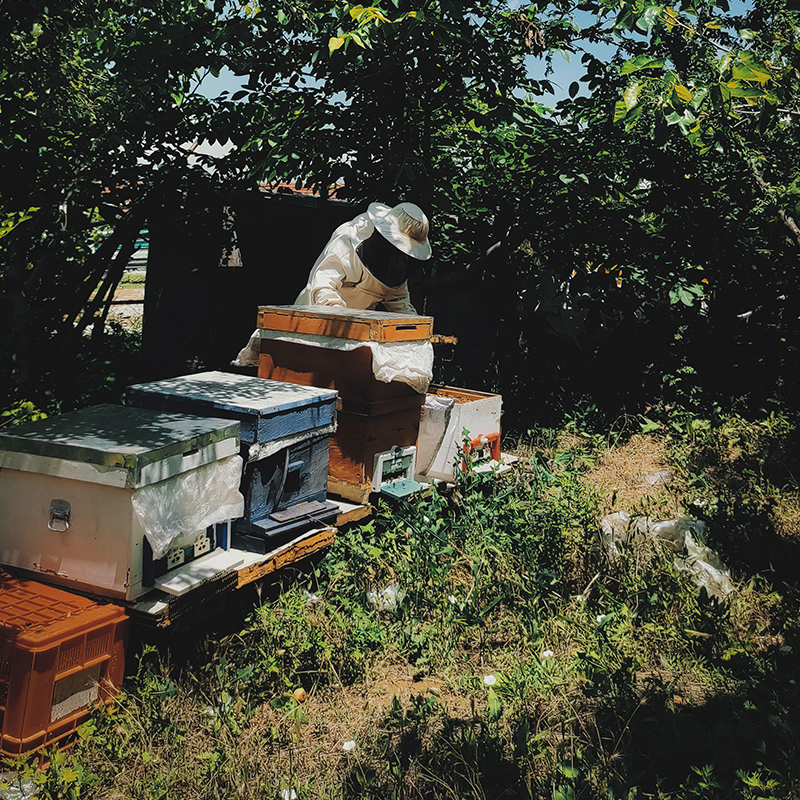
Within the Green Movies project, Il Pianeta Naturale aims to present Nature as a laboratory of solutions tested over millions of years of history. In this briefing, the protagonist is the hive: a community of tens of thousands of individuals that, without a leader issuing orders, manages to organize itself, communicate, make collective decisions and secure a future for subsequent generations.
The natural history of bees is closely intertwined with the principles of GreenComp, the European sustainability competence framework.
This briefing draws inspiration from an excerpt from The Life of the Bee by Maurice Maeterlinck, winner of the 1911 Nobel Prize in Literature: “...to arrive finally, step by step, at the almost perfect but pitiless society of our hives, where the individual is entirely absorbed by the Republic, and where the Republic in turn is regularly sacrificed to the abstract and immortal City of the future.”
Key Points of the Briefing
• Solutions to complex systemic problems, already found by nature millions of years ago, through individual actions that generate collective decisions by the superorganism.
• The invention of a sophisticated language, the bees’ dance, capable of conveying precise messages about distant resources.
• A vision of life beyond one's own horizon, ensuring a future for the “spirit of the community”, namely the hive.
• Biodiversity among full and half-sisters, an essential resource for withstanding extreme environmental challenges.
Solving Complex Problems
How do bees know when they need to replenish the stores required to feed newly emerged bees and the rest of the colony, which may number tens of thousands of individuals? The queen makes no operational decisions, and no worker decides for the others. Yet the small choices made by individual bees (foraging, warming, cooling, feeding and defending) produce the overall response of the entire superorganism.
This is a mechanism of self-organization: when stores run low or the temperature changes, more individuals respond to that stimulus. Hundreds of bees performing simple, local actions thus generate a collective “decision” for the Republic: not because someone gives an order, but because the system converges on the most useful solution. It is a highly effective example of systems thinking: the parts interact, and the outcome is not simply the mechanical sum of individual behaviours.
It is somewhat like a quantum computer (though it is not a quantum mechanism): no single bee makes the decision; instead, many parallel actions are “pooled”. Solutions that work are amplified and become the colony’s response. This is an example of distributed processing and collective convergence.
The Waggle Dance
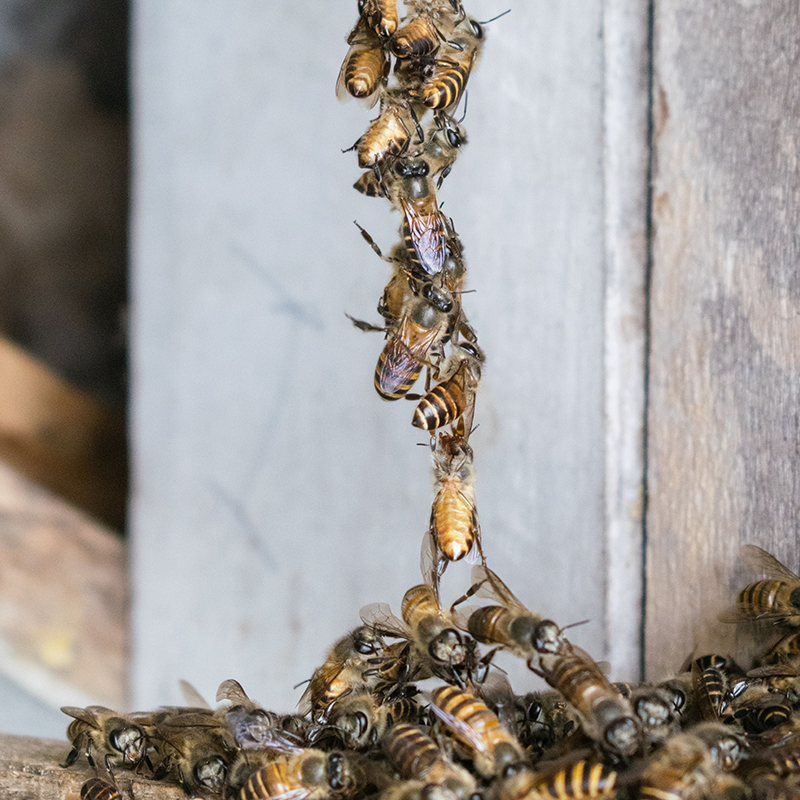
One of the hive’s most extraordinary achievements is the bees’ dance, or waggle dance, discovered and interpreted by Karl von Frisch (for which he received the Nobel Prize in 1973). Who invented it? That remains a mystery! With a brain the size of a sesame seed, a forager (an adult worker bee that leaves the hive to gather resources needed for the survival of the entire colony) can communicate to her companions the location of a source of nectar, pollen, water or resin, even if it is kilometres away and somewhere they have never visited before.
The dance takes place on vertical combs and traces a figure of eight. During the straight section, known as the waggle run, the bee vigorously shakes her abdomen from side to side, producing low-frequency sound vibrations with her wings, typically around 250–300 Hz. The main message is conveyed through movement, contact with other bees, vibrations and chemical signals.
The duration of the waggle run encodes distance: the longer the bee vibrates, the farther away the source. Direction is encoded by the angle between the waggle run and the vertical axis of the comb: this angle corresponds to the angle between the flight route towards the food and the Sun’s current position on the horizon (including any drift caused by the wind). The bee must therefore remember the route, calculate its relationship to the Sun and translate it into a “space-time” language that can be understood in the darkness of the hive.
Bees following the dance do not receive an order: they touch the dancer with their antennae, sense her vibrations, memorize the information and then fly out to verify it. Experienced foragers can thus guide small groups of inexperienced bees towards feeding grounds, but final confirmation always comes from direct experience and the scent of the source. This is a system of cultural and practical transmission: the colony does not merely inherit instincts but shares useful information to cope with its environment.
An adult forager often lives only a few weeks during the active season, yet the knowledge accumulated by the previous generation (routes, flowers, seasons and risks) continues to guide the next.
A Life Beyond One’s Own Horizon
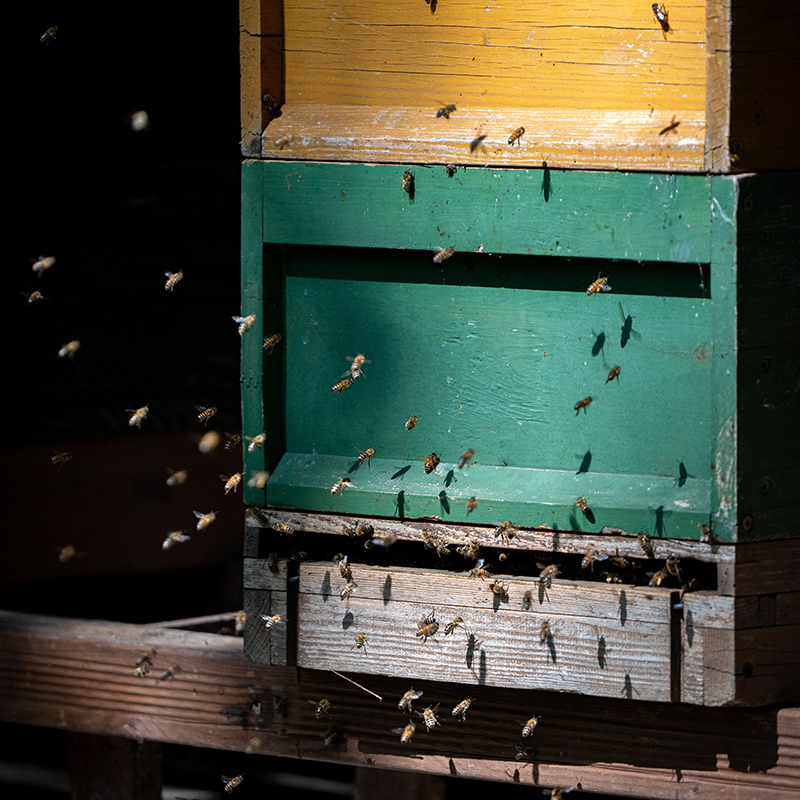
The worker bee labours for a family whose full development she will never see: she feeds larvae, builds combs, defends the hive entrance, cools (or warms) the hive and stores provisions for winter. Her own horizon is short, but her actions support the continuity of the colony.
This is the most powerful dimension of Maeterlinck’s quotation: the individual is absorbed into the Republic, but the Republic exists to ensure a future beyond any single generation. For sustainability education, this is not an invitation to erase the individual, but rather to understand that personal choices also gain meaning through their effects on communities, ecosystems and future generations.
Internal Biodiversity
Diversity is a resource even within the hive. The queen mates with many drones, generally around a dozen and sometimes as many as twenty; consequently, the workers are not all full sisters but belong to different paternal lineages, or patrilines, with different fathers.
This genetic variability translates into the ability to respond in different ways, ready to be activated by different environmental inputs: some bees are more inclined to forage, others to care for brood, defend the hive, cool it or search for water. Some foragers are very active and industrious, making numerous trips a day, while others are less inclined to venture out; but when the colony needs them, even the less active bees can be mobilized. Diversity among full and half-sisters is not a flaw: it is a genetic reserve of solutions. When the environment changes (heat, drought, lack of flowering plants or parasites), the colony is more likely already to have individuals capable of responding appropriately. The same principle makes ecosystems resilient: greater diversity of species, genes and roles means a greater capacity to adapt.
Connections to GreenComp
GreenComp identifies four interconnected areas: embodying sustainability values, embracing complexity, envisioning sustainable futures and acting for sustainability. The story of the hive can provide a concrete entry point into each of them.
| GreenComp Area | Connection to the Republic of Bees |
|---|---|
| Embodying sustainability values | The hive invites us to recognize that humans are part of nature and that the lives of other species have intrinsic value that deserves respect and protection. Bees demonstrate cooperation, care for offspring and responsibility for the continuity of the community, without reducing the individual to a mere instrument. |
| Embracing complexity | No bee “commands” the hive, yet the colony solves complex problems: temperature regulation, foraging, defence and allocation of work. This is a model of systems thinking in which small local actions generate collective outcomes. |
| Envisioning sustainable futures | The waggle dance is a language that projects the present towards a place yet to be reached: it points to a resource the other bees have not yet visited. The colony also organizes stores and roles with future seasons in mind. It is an image of adaptability, memory and foresight. |
| Acting for sustainability | Each bee contributes according to her abilities and the context: some forage extensively, others less so, but all can respond when the community needs them. The message is that individual initiative and collective action are not mutually exclusive: they reinforce each other. |